This kind of application has to locally process the information from a large number of sensors at extremely high speeds; central processing via the cloud would be much too slow and error-prone. The solution: "Fog Computing". This architecture approach leverages the miniaturization of sensor technologies and computing power to evaluate and prepare data, for example on street traffic volumes, on a task-specific basis directly on location via mobile edge (see Glossary). In the HardFOG project Fraunhofer researchers from Fraunhofer IZM and Fraunhofer FOKUS intend to construct miniaturized versions of various sensor nodes in the form of high-performance sensor systems. This is to be done by integrating chips, memory modules, interfaces and energy-saving voltage transformers in the sensor nodes themselves.
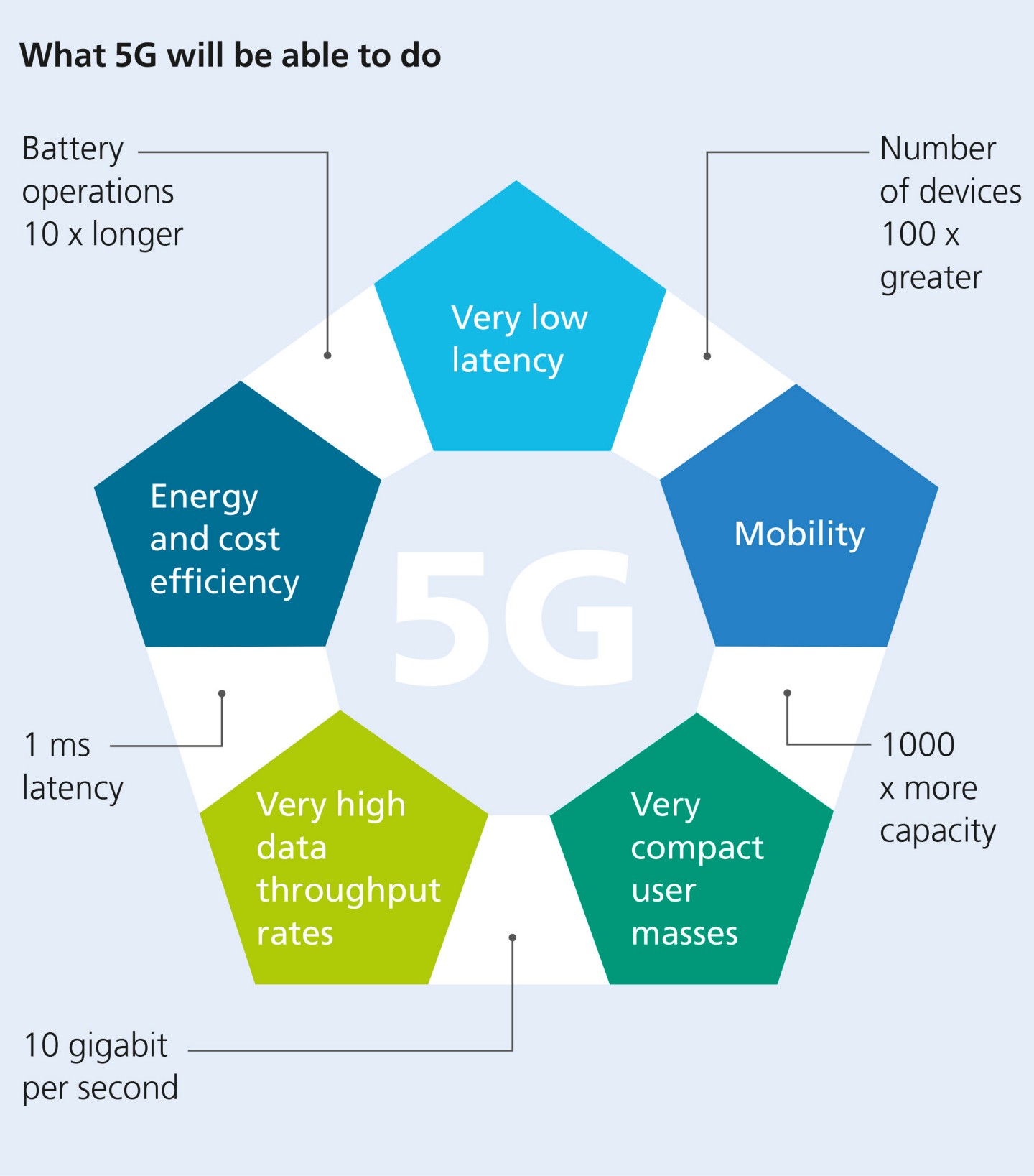
Several projects are specifically addressing the aspect of energy efficiency: ultra-fast transmission networks are useless when the batteries of the many distributed sensors run out of power too quickly. The researchers are convinced that with 5G it will be possible to prolong the operating times for low-energy sensors by up to ten times and are speculating on battery lifetimes of as long as 15 years. "At the High Performance Center for Electronic Systems in Erlangen we're researching the topic of reducing power consumption for the Internet of Things to an absolute minimum," explains Professor Albert Heuberger, Director of the Fraunhofer IIS. Intelligent tracking systems will soon take over positioning tasks using a fraction of the amount of energy typical today.
Innovative materials such as gallium nitride are to help increase energy efficiency as well. This semiconductor material can be used to create energy-saving and high-performance mobile communications transmission amplifiers. Since this way more operational frequencies are available, it is possible not only to significantly increase range but also the rates at which data can be transmitted. "This way we not only make the best possible use of LTE standard potentials, we're also creating the optimum prerequisites for the implementation of 5G," explains Professor Oliver Ambacher, Director of the Fraunhofer Institute for Applied Solid State Physics IAF. Professor Ambacher's contribution to the development of highly efficient power amplifiers was recognized with the 2015 Karl Heinz Beckurts Prize.
Hardware will have to change to accommodate future networks. "New hardware components will be necessary in order to process these enormous data volumes at the highest possible speeds while at the same time consuming as little energy as possible," emphasizes Professor Hubert Lakner, Chairman of the Board of Directors of the Fraunhofer Group for Microelectronics. Together with partners in industry, Fraunhofer is developing a new generation of semiconductor processes which will enable the cost-effective manufacture of transistors offering minimal latency and low energy consumption.
Of course taking full advantage of 5G will also mean that terminal devices for consumers will have to change as well. The 2018 Olympic Winter Games in South Korea, where pioneer applications will be demonstrated on a wide-scale basis, will provide a glimpse of how this will look. Spectators in the stadiums will be able to use their virtual reality glasses to zoom in closer to the action, access slow motion replays and bet on winners in ad-hoc online polls. Nevertheless scientists don't expect a Big Bang in the conversion to 5G, but rather a characteristic evolutionary development which will integrate existing landline and mobile broadband networks in the new network landscape.
 Fraunhofer-Gesellschaft