Research, Demonstration, Knowledge
The Fraunhofer Center demonstrates exemplary ways in which existing properties can be renovated effectively in a sensible and energy-efficient way and how listed historic monuments can be retained, based on the four pillars of research, demonstration, knowledge gathering and knowledge transfer. The topics cover the fields of energy efficiency, economy, ecology and the durability of renovation measures as well as the development of new and innovative materials and technologies, the use of renewable energy in the building stock and energy efficiency in the urban building context.
The Center fills a gap in the field of renovation of old properties and preservation of historic monuments. In the opinion of Prof. Dr. Klaus Sedlbauer, the head of the Institute at the Fraunhofer IBP: “It is our aim to link together in the best possible manner research, the demonstration of possible solutions, the gathering of knowledge in the field of energy-efficient renovations and its dissemination in a manner appropriate to the historic monuments, as well as explaining these aspects in a manner which the public can comprehend. Because of the global challenges and the stock of buildings in need of energy-efficient renovation, an establishment in the form of a transparent construction site that can serve as a model is urgently needed”.
Cooperation partners
Together with cooperation partners from the building industry, here it is possible to study and optimise innovative materials and/or product combinations and techniques directly on the building. All research projects relating to the different questions and materials are accompanied, investigated and subsequently evaluated by the Fraunhofer IBP using measurement technology.
“What we are aiming to do here in the Alte Schäfflerei is to show all the various aspects of monument preservation with regard to historic buildings. This starts with protecting the façade, from the renovation of damp masonry foundations and the preservation of historic windows to questions of domestic engineering and what sort of long-term maintenance and care are necessary. Here we are making important progress in the further development and establishment of modern methods relating to energy-efficient renovation of historic buildings,” observes Prof. Dr.-Ing. Dipl.-Restaurator Univ. Ralf Kilian, who is coordinating the research work at the Fraunhofer IBP.
Exchange and networking
Exchange and interdisciplinary work with partners within the network is a top priority for all activities. “In the Old Smithy, the former caretaker’s premises, we have created a workshop in which our industrial partners have an opportunity to demonstrate their work or carry out training courses for craftsmen. On the upper floor there are rooms for seminars and public information events. These are aimed not only at scientists but also at craftsmen, building contractors and interested individuals. Young people are a particular concern; in future we plan to organise events specifically for them,” explains Christine Milch, the coordinator of the Center.
The energy-efficient renovation of the Alte Schäfflerei in line with its status as a historic monument
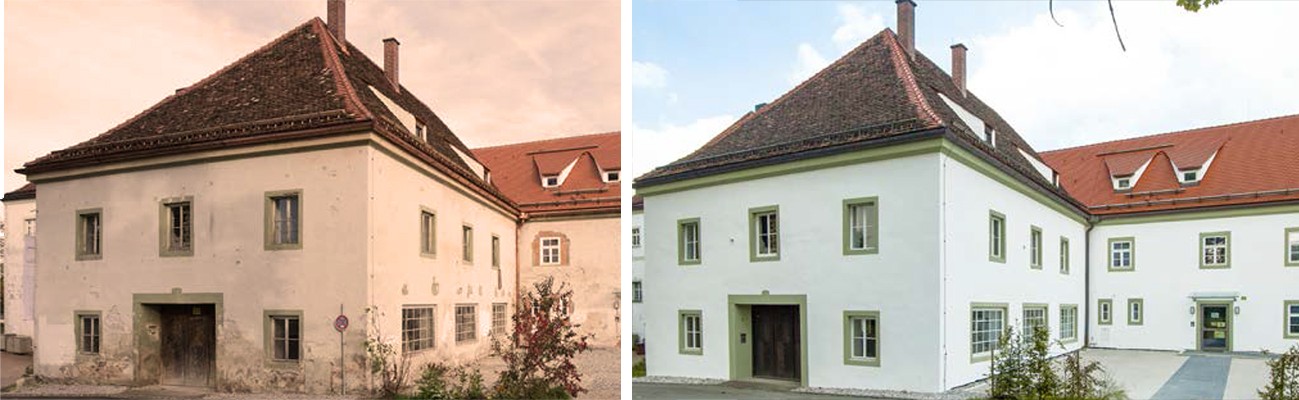
In 2010 the contract for the use of the Alte Schäfflerei was signed between the Abbey of Benediktbeuern and the Fraunhofer Institute for Building Physics IBP. It was during that same year that the inter-disciplinary research project for the renovation of the historic building was inaugurated. During the six-year duration of the project the Alte Schäfflerei was renovated in line with its status as a historic monument and in an energy-efficient manner. The various building procedures were presented in a sort of living, transparent building site. One of the most complicated tasks was the renovation of the roof timbering with its elaborate supporting hanging truss. It was possible to retain 95 percent of the historic old wood and some of the old roof tiles; the new tiles were fired in line with historic practice.
For the part of the project relating to the interior insulation the scientists mounted ten different insulating materials which are very thin but which provide very good heat insulation, or which were made from renewable or recycled materials, on the walls of the upper floor, which measures over 200 square meters. The insulation measures were accompanied by measurements and mathematical investigations in order to explore the advantages and disadvantages of the different systems. In a historic building like the Alte Schäfflerei the scientists consider it particularly important that it should be possible to reverse all measures so that the valuable historic building substance can be retained. For this reason the insulation can be easily removed again without damage to the plasterwork and masonry.
The location in the Abbey of Benediktbeuern as a historic site and listed monument is very appropriate for the Fraunhofer Center as a place for encounters and knowledge transfer. Interested parties will find a visit there very rewarding.
 Fraunhofer-Gesellschaft